
The Empire of Trebizond: A Guide to Exploring the Komnenos Legacy
Many visitors to Trabzon see Sümela Monastery and Uzungöl, then head home. Yet the city itself was the capital of an independent state for 257 years. The Empire of Trebizond (the Komnenos Dynasty) ruled the Black Sea coast from 1204 to 1461. It left behind walls you can still explore on foot, mosques converted from churches, a fresco-filled Hagia Sophia and a monastery set among the mountains. In this guide, we explain the best order to see this heritage, how much time to spend at each site, and the mistakes visitors make most often.
What Was the Empire of Trebizond? A Short, Clear History
In 1204, shortly before the Crusaders captured Constantinople, Alexios and David Komnenos, grandsons of the Byzantine emperor Andronikos I Komnenos, founded a state in Trabzon with the backing of Queen Tamar of Georgia. Its rulers took the title "Grand Komnenos." The state was small, covering roughly today's Eastern Black Sea coastline and the valleys behind it. But it had one major advantage: the caravan route from Tabriz reached the sea at the port of Trabzon.
Thanks to this trade route, Venetian and Genoese merchants settled in the city, and the silk and spice trade flourished. Marco Polo is said to have passed through Trabzon on his way back from Asia at the end of the 13th century. The state survived by forging marriage alliances with its powerful neighbours, and Komnenos princesses were married to Aq Qoyunlu and Turkmen rulers. In 1461, Sultan Mehmed the Conqueror besieged the city and the last emperor, David, surrendered. With that, one of the last independent fragments of the Byzantine world became part of the Ottoman Empire.
Knowing this history makes it easier to understand what you see on your trip: most of Trabzon's historic buildings were either built during the Komnenos period or were given a new purpose under the Ottomans.
Trabzon Castle and Ortahisar: The Heart of the Empire
The city's name comes from the Ancient Greek word trapeza, meaning "table." It describes a flat plateau between two deep valleys. This "table" is the area known today as Ortahisar, with the Zağnos Valley to the west and the Tabakhane Valley to the east. The Komnenos emperors built their palace and walls along this natural line of defence.
A three-tiered system of walls
- Yukarıhisar (Citadel): The highest section, to the south, where the imperial palace once stood. Today its remains can be seen in fragments.
- Ortahisar: The city centre between the two valleys, and the best place to see the walls.
- Aşağıhisar: The section that descends towards the sea, linking the city to the coast.
The landscaped park in the Zağnos Valley and the historic Zağnos Bridge are the easiest spots for viewing the walls from below. The Tabakhane Bridge side is quieter and offers a more natural backdrop for photos.
Fatih Mosque: the "Golden-Headed" church
Fatih Mosque (Ortahisar Grand Mosque) in Ortahisar was once Panagia Chrysokephalos, the main church of the Komnenos era. "Chrysokephalos" means "golden-headed," and it is said to take its name from the dome that was once gilded. The emperors were crowned here. After the conquest, it was converted into a mosque. Inside you will find a simple space, but the building's layout and scale still reveal that it was once an imperial church.
Trabzon Hagia Sophia: The Best-Preserved Komnenos Monument
 The Wedding at Cana fresco in Trabzon Hagia Sophia, Komnenos period — Photo: Dosseman, Wikimedia Commons, CC BY-SA 4.0
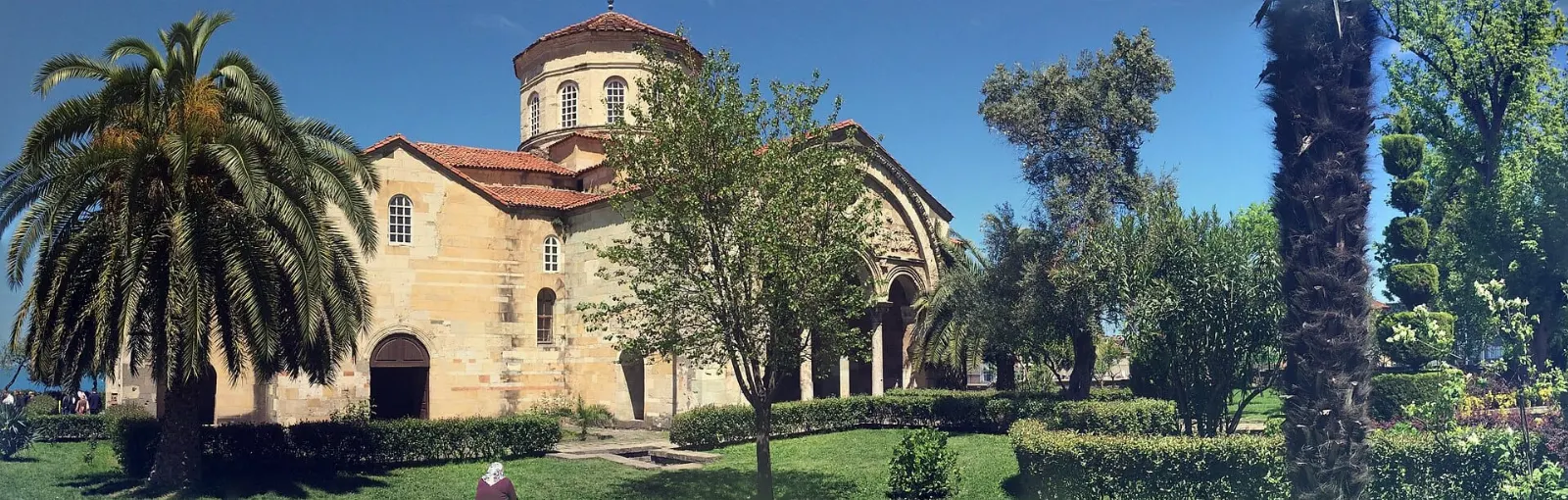
The most impressive surviving building from the Empire of Trebizond is Hagia Sophia, set on a hill overlooking the sea on the west side of the city. It was built in the mid-13th century during the reign of Emperor Manuel I. Two things make it special: the stone carvings on its exterior and the frescoes inside.
- South façade frieze: Reliefs telling the story of Adam and Eve, together with Seljuk-influenced geometric ornamentation, make this one of the rare places where Byzantine and Anatolian art meet.
- Frescoes: Scenes such as the Wedding at Cana, Jesus at the Sea of Galilee, the Nativity and the Ascension are considered fine examples of late Byzantine painting.
- Bell tower and garden: The separate tower beside the main building and the sea-view garden offer a peaceful end to your visit.
Hagia Sophia is currently used as a mosque. Visits may be restricted during prayer times, and some frescoes may be covered with curtains during worship. As visiting arrangements change from time to time, we recommend checking the latest information before you go. Women visitors should bring a headscarf, and everyone should wear clothing that covers the shoulders and knees.
Kızlar Monastery, Yeni Cuma Mosque and Other Traces Around the City
The Komnenos legacy is about more than the castle and Hagia Sophia. A few more stops around the city round off the day for history lovers.
Kızlar Monastery (Theoskepastos)
Set at the foot of Boztepe and built around a cave church nestled against the rock, this monastery is one of the religious sites supported by the Komnenos family. Reopened to visitors after restoration work, its terrace offers lovely views of the city and the sea. Heading up from here for a tea break at the Boztepe Viewing Terrace is one of the most enjoyable combinations you can make.
Yeni Cuma Mosque (Church of St. Eugenios)
Built in honour of Eugenios, regarded as Trabzon's patron saint, this church was converted into a mosque after the conquest. Sultan Mehmed the Conqueror is said to have performed his first Friday prayer in the city here, which is how the mosque got its name.
Small details tucked between the walls
As you stroll the streets of Ortahisar, you will spot houses built against the city walls, remains of old gates and fountains added in the Ottoman period. These details have no signs, and this is exactly where a guided walk makes the biggest difference.
The Greatest Komnenos Legacy Outside the City: Sümela Monastery
Sümela Monastery is far older than the empire, but it enjoyed its golden age during the Komnenos period. The emperors, especially Alexios III, granted the monastery extensive lands and privileges; with this support, it grew to become one of the most important religious centres in the region. Seeing this structure in the Altındere Valley, which looks as if it were carved into the cliff face, is the natural next chapter in the story of the Empire of Trebizond.
For information on visiting arrangements, walking distances and photography, take a look at our Sümela Monastery visitor guide. Rather than squeezing the city-centre sites and Sümela into a single day, splitting them over two days lets you enjoy both. If you would rather not worry about transport, parking and the walk in the valley, you can go there and back with a guide on our Sümela Tour.
Things to Do on the Trail of the Empire of Trebizond
This experience isn't limited to sightseeing. You can also add the following activities to a history-focused trip to Trabzon:
- Historic walk along the walls: A short walk starting in the Zağnos Valley, climbing up to Ortahisar and continuing to Fatih Mosque is the best way to appreciate the scale of the castle.
- Fresco and architecture photography: The south façade of Hagia Sophia looks best in the morning light, while the garden is better in the afternoon. Do not use flash inside.
- Aquarium visit in the valley: Opened in the tunnel connecting the Zağnos and Tabakhane valleys, the Aquarium adds a fun break to your historic walk, especially for families with children.
- Museum visit: Trabzon Museum in the city centre displays artefacts from the region's different eras; check whether it is open before your visit.
- Bazaar and tea break: Shopping for local products in the bazaar on the way down from Ortahisar to Meydan, followed by a glass of tea, is the perfect way to end the day.
When to Go and How Much Time to Allow
The Komnenos sites in the city can be visited all year round. That said, there are a few seasonal differences:
- Spring and autumn: The most comfortable time for walking, with fewer crowds and cooler weather.
- Summer: Hagia Sophia and Sümela can get busy, so go early in the morning.
- Winter: The city sites are easy to visit; an umbrella and non-slip shoes are a must for the Black Sea rain.
Recommended time
- Hagia Sophia: 45–60 minutes
- Ortahisar, Fatih Mosque and the walls: 1.5–2 hours
- Kızlar Monastery and Boztepe: 1.5 hours
- Sümela Monastery: half a day (a separate day is recommended)
Common mistakes
- Visiting Hagia Sophia at Friday noon: You may not be able to see the interior during Friday prayers.
- Thinking the castle is "a single building": Trabzon Castle isn't one structure but a system of walls spread throughout the city; if you don't know where to look, you may walk right past it.
- Trying to fit everything into one day: Those who try to see the city centre and Sümela on the same day usually end up rushing through both.
A guided Trabzon City Tour brings together highlights such as Hagia Sophia, the Atatürk Pavilion and Boztepe in a single day, with no traffic or parking hassles. For those who want to see the Eastern Black Sea in a few days, our Black Sea Tour combines the city's history with highland and nature stops.
Frequently Asked Questions
Can I see the Empire of Trebizond sites on a single tour?
Many of the sites in the city are included on the Trabzon City Tour route. Sümela Monastery is visited on a separate day with the Sümela Tour. Planning the two tours on consecutive days is the most convenient option.
What time do the tours start and what is included in the price?
Our tours depart from Trabzon; start times, pick-up points and the services included in the price are listed on each tour page. For the latest information, simply message us on WhatsApp.
Do you offer private tours for families or groups?
Yes. In addition to group tours, we organise private tours for your family or group with a dedicated vehicle and driver, scheduled around you. If you have a particular interest in history, we can build the route around Hagia Sophia, Ortahisar and Kızlar Monastery.
How can I book?
You can book online via the tour page, or reserve your spot by sending us your preferred date and number of guests on WhatsApp.
Conclusion
The Empire of Trebizond is the most compelling story that sets Trabzon apart from an ordinary coastal city. The frescoes of Hagia Sophia, the walls of Ortahisar, the golden-headed past of Fatih Mosque and Sümela's striking presence in its valley are the chapters of this story that still stand today. Exploring this heritage knowing what to look for, without rushing and with an expert guide, turns your visit to Trabzon into far more than a sightseeing trip.
Cover photo: Panoramic view of Trabzon Hagia Sophia — Photo: User:Balkanique, Wikimedia Commons, CC BY-SA 4.0