
Trabzon Means Sümela: The History of Sümela Monastery and the Story of Panagia Sumela
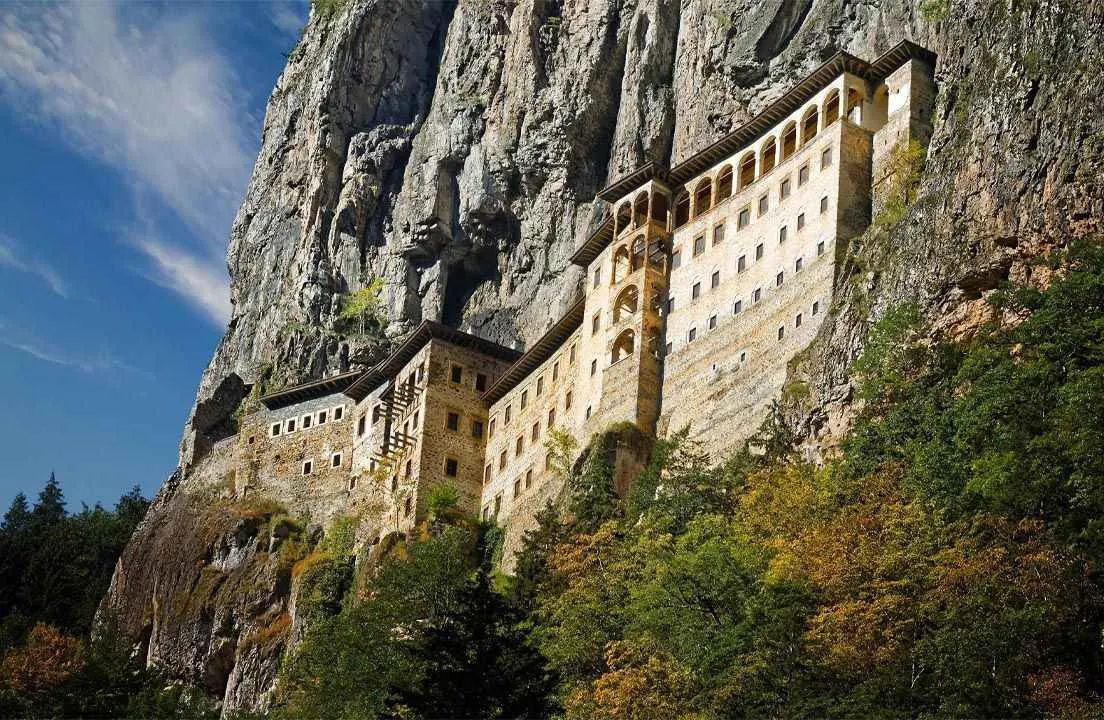
The history of Sümela Monastery is a long story that began with a dream and was woven over the centuries from prayers, imperial decrees and farewells. Clinging to the sheer slopes of Karadağ in Maçka, overlooking the Altındere Valley, this monastery is known to the Orthodox world as Panagia Sumela, meaning the Virgin Mary of Mela. In this article, we tell the story of Sümela Monastery, from its founding legend to the farewell of 1923, and from the journey of its icon to the liturgies held there today.
If you're curious about practical matters such as admission, the walking trail and visiting hours, take a look at our Sümela visitor guide. Here, we focus solely on the monastery's story.
Let's start with a brief timeline:
- 4th century: According to legend, Barnabas and Sophronios found the monastery; its founding is generally dated to around 386.
- 6th century: It is said to have been restored and expanded during the reign of Emperor Justinian.
- 1365: Its privileges are secured by a golden-sealed charter issued by Emperor Alexios III of Trebizond.
- 1461: Sultan Mehmed the Conqueror, having taken Trabzon, places the monastery under his protection.
- 1923: With the population exchange, the monks leave the monastery.
- 1931: The icon, which had been buried in the ground, is unearthed and taken to Greece.
- 2010: The 15 August liturgy is held at the monastery for the first time in many years.
- 2015-2022: Restoration work to address the risk of rockfalls; the monastery fully reopens on 1 May 2022.
A story that began with a dream: Barnabas and Sophronios
According to legend, two monks from Athens, Barnabas and Sophronios, had the same dream on the same night. In the dream, the Virgin Mary told them that her icon, believed to have been painted by Saint Luke, was waiting in a cave on a distant mountain, and asked them to travel east to Trabzon. The two monks set off and, after a long journey, found the cave and the icon on the slopes of Karadağ. Some versions of the story even say the icon was carried to the cave by angels.
The monastery was built around this cave, nestled against the rock face. The exact date of its founding is unknown; sources generally point to the reign of Byzantine Emperor Theodosius I, around 386. While the details of the legend vary from one storyteller to the next, its essence stays the same: Sümela is a monastery born around an icon.
The Panagia Sumela icon
Panagia is a title used in Greek for the Virgin Mary, meaning all-holy. The name Sümela is thought to derive from a Pontic Greek expression meaning at Mela. Mela is associated with the word for black, and fittingly, the mountain the monastery leans against is called Karadağ, the Black Mountain, today.
The icon itself depicts Mary holding the infant Jesus and, according to tradition, is attributed to Saint Luke. The monastery owes much of its fame to this icon; for centuries, pilgrims walked long distances to Sümela to pray before it.
From Byzantium to the Empire of Trebizond
The monastery is said to have been restored and expanded in the 6th century by the general Belisarius during the reign of Emperor Justinian. However, it received its most important privileges during the Empire of Trebizond, founded in 1204. Alexios III of the Komnenos dynasty secured the monastery's autonomy and tax exemptions with a golden-sealed charter dated 1365. You can discover other traces of this era in the city in our article on the Empire of Trebizond and the Komnenos legacy.
Sümela in the Ottoman era
After taking Trabzon in 1461, Sultan Mehmed the Conqueror placed the monastery under his protection and recognised its privileges; later sultans renewed these rights as well. The monastery underwent major repairs, particularly during the reigns of Selim III and Mahmud II. In the 18th century, many of its sections were renovated and some of its walls were adorned with frescoes. In the rock church, there are surfaces where layers of frescoes from different periods can be seen one on top of another.
The monastery is not a single building. Around the rock church at its centre, chapels, monks' and students' cells, guesthouses, a bell tower and cellars are arranged in tiers along the cliffside. Following the restoration, some of these sections have welcomed visitors again for the first time in years.
If you'd like to photograph these frescoes and the monastery's façade, our article on photo spots at Sümela will come in handy.
1923: The farewell and the icon's journey
With the Turkish-Greek population exchange that followed the Treaty of Lausanne, the monks left Sümela in 1923. The exchange was a profound rupture that changed the lives not only of Sümela but of many families along the Black Sea. It is said that before leaving, the monks buried the icon and some valuable objects in the ground. The monastery was left empty, and a fire in 1930 destroyed much of its wooden sections.
In 1931, during a period of rapprochement between the two countries, Ambrosios, one of Sümela's monks, came to Trabzon with the permission of the Turkish government and unearthed the buried icon. The icon was kept for a time in a museum in Athens. In the early 1950s, it was moved to the Panagia Sumela Monastery established in Kastania, on Mount Vermio in Greece's Macedonia region, where it is still preserved today.
The 15 August liturgy and restoration
15 August is the day on which the Orthodox calendar commemorates the Dormition and Assumption of the Virgin Mary, and it is a special date for Sümela, too. In 2010, with official permission, this liturgy was held at the monastery for the first time in many years. Since then, it has been repeated in many years; in some it was led by Ecumenical Patriarch Bartholomew, and in others it was moved to a different day. During the liturgy, Trabzon welcomes Orthodox visitors from various countries. The date and conditions of the liturgy are announced separately each year.
The monastery itself has also been through a challenging period. Closed to visitors in September 2015 due to the risk of rockfalls, Sümela underwent extensive restoration and rock reinforcement work. During this process, a chapel reached through a secret passage, featuring frescoes depicting heaven and hell, was brought to light along with ascetic cells. The monastery partially reopened to visitors in 2019 and fully reopened, with all its areas, on 1 May 2022.
Sümela's place in Trabzon's identity
Today, one of the first images that comes to mind when you think of Trabzon is that rocky façade rising out of the forest. Sümela was added to the UNESCO World Heritage Tentative List in 2000 and, according to figures reported in the news, welcomed more than 500,000 visitors in 2025. But for the people of Trabzon, the monastery is more than a tourist stop: it is one of the most visible reminders of the city's multi-layered past, where different faiths and eras meet on the same cliff.
Before you reach the monastery, Altındere's dense forests and the stream flowing along the valley floor set the stage for a fitting introduction to this story. Seeing Sümela with its history in mind means seeing centuries as you gaze up at the cliff.
We've gathered what else Trabzon is famous for besides Sümela in our article on what Trabzon is famous for; if you're coming to the city for a match, our article on Trabzonspor matches and Trabzon trips will also come in handy.
Our guided Sümela tour includes stops such as Karaca Cave, Zigana and Hamsiköy alongside the monastery; we take care of the route, the timing and the itinerary, so all you have to do is enjoy the moment.
You can view dates, prices and the itinerary and book online on the Sümela Tour page. If you'd like a plan tailored to you or your group, message us on WhatsApp and let's plan the route together.
Frequently asked questions
What time does the Sümela Tour start?
Departure times and tour days may vary by season. You can find the current schedule on the Sümela Tour page. If you add the hotel pickup option, your pickup time will be arranged according to the departure time and communicated to you in advance.
Is the history of the monastery explained on the tour?
Yes. Our tours include guiding in Turkish; our guide shares information about Sümela and the other stops throughout the day. If you read this article before you come, it will be all the more enjoyable to ask about and discuss the founding legend or the icon's journey on site.
Can we arrange a private Sümela tour for our family?
Yes. In addition to the group tour, we also offer a private tour option with a dedicated vehicle and driver. On a private tour, we decide on the times and stops together; if you're travelling with children or elderly family members, we can prepare a plan that suits your pace. You can also find suggestions in our Trabzon trip with kids article.